In the DIHK Newsroom, you’ll find the latest press releases, statements, studies, and background information on the German economy—presented in a concise, well-organized, and always up-to-date...
Growth, innovation, and speed of change in Germany are often hindered by what are felt to be endless planning and approval processes. This applies to the transition to a climate-neutral industry, comprehensive broadband expansion, the development of vibrant cities and municipalities, or the renovation and expansion of roads, railways, and waterways.
Delayed procedures undermine businesses' trust in efficient governance. These businesses require a strong tailwind from agile authorities to invest effectively.
Speed is achievable
During the gas crisis, politics demonstrated their capability: by breaking through central barricades and old patterns with LNG terminals and exceptions for fuel switch policies. On November 6, 2023, the federal and state governments adopted these experiences in the so-called Acceleration Pact and resolved numerous measures intended to achieve the proclaimed "Germany tempo." They agreed on 150 initiatives for faster and simpler procedures, including numerous administrative changes such as digitalization and staffing. On June 18, 2025, Germany resolved to fully implement the pact halfway through its 21st legislative period. The Federal Modernization Agenda of December 4, 2025, outlined further measures.
The resolutions address key demands from the IHK network for faster approval procedures—spanning simple construction permits to complex planning approval processes. To achieve impact, however, the pact must be fully implemented across the various specialized laws regarding planning and approval legislation. The DIHK Acceleration Monitor observes the implementation status of the economically crucial legislative measures, ranging from "predominant public interest" to the "limitation of suspensive effects" (see below). Measures are assessed based on their initiation in essential laws and the extent of enactment.
Implementation remains piecemeal
With the Telecommunications Act amendment, the new federal government promptly started acceleration legislation, defining "predominant public interest" for broadband expansion. Similar approaches are evident in drafts for hydrogen and geothermal acceleration laws, albeit with restrictions previously applied by past governments concerning nature conservation. Furthermore, many regional building codes introduced deeming approvals or shortened deadlines.
In December 2025 and January 2026, the federal cabinet initiated additional pivotal acceleration laws: The Infrastructure Future Act draft defines "predominant public interest" for various transportation projects, simplifies provisional orders, and eases species conservation regulations. Changes to Environmental Legal Remedies are proposed to preclude delayed objections in judicial processes, alongside Federal Emission Control Act reforms aiming to simplify numerous approval procedures.
However, these legislative drafts also reveal gaps: "predominant public interest" applies only to a fraction of planned highway projects. Approval deeming is limited to specific procedures—like repowering wind turbines or broadband expansion. Key deadlines for substantial factual and legal scenarios remain absent. Binding deadlines in planning approval procedures and public participation processes exceed EU legal requirements.
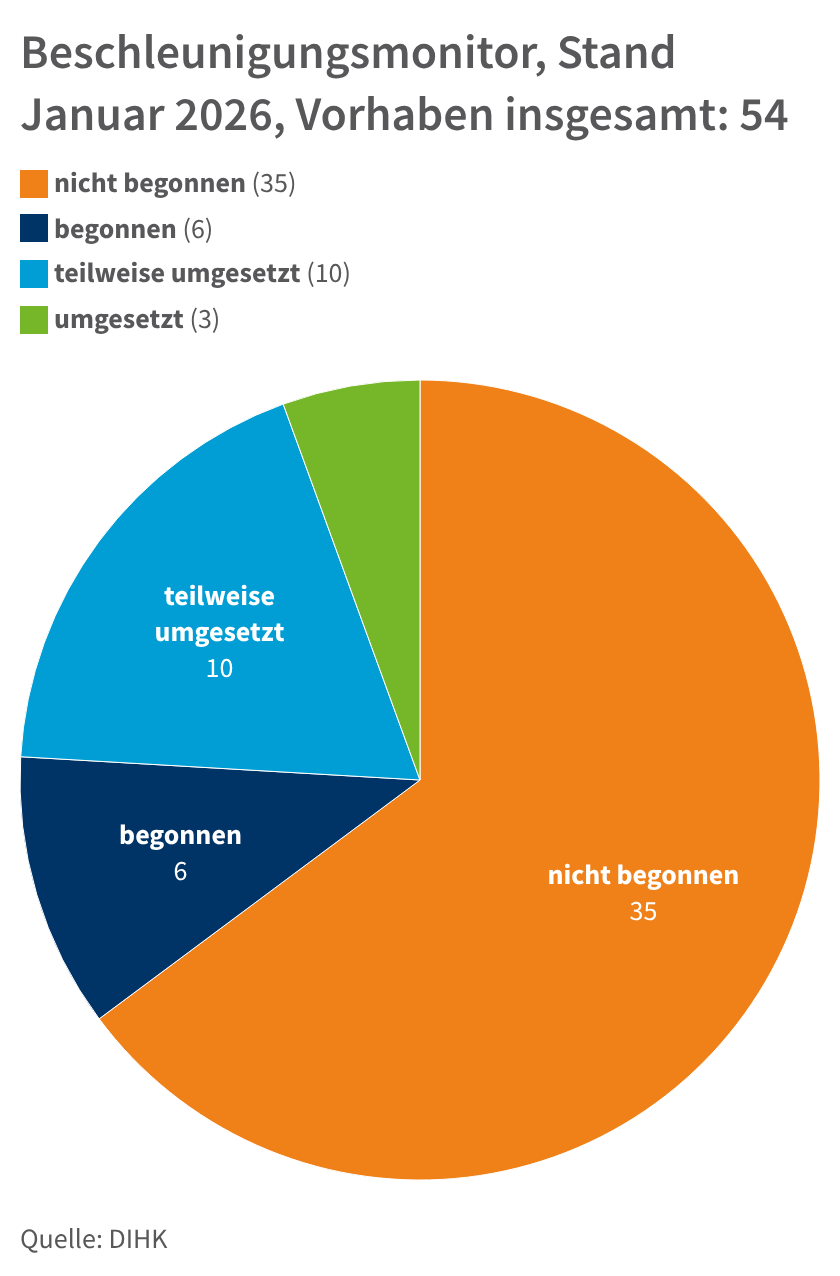
Instead of extensive reform, piecemeal actions persist: only 3 out of 54 necessary legislative changes are fully incorporated and 10 partially implemented. Another 6 measures have entered parliamentary processes. Yet, a large portion of the announced measures awaits initiation.
Individual measures under observation
The DIHK Acceleration Monitor investigates the realization of the resolutions from the Planning, Approval, and Implementation Acceleration Pact between federal and state administrations of November 2023 and the coalition agreement between CDU/CSU and SPD from March 2025. The measures must anchor themselves across various specialized laws to ensure implementation across all economic sectors.
Here, only the ten most crucial measures are analyzed based on specialized laws and economic significance. The following evaluations trace the implementation into relevant laws:
A rule change qualifies as "initiated" with a draft (e.g., cabinet proposal).
"Partially implemented" measures apply exclusively to certain initiatives (e.g., renewable energy ventures or housing projects).
"Entirely implemented" measures work universally.
The status of the 10 most important initiatives
The designation of the exceptional public interest for specific projects provides government agencies with a prioritization during considerations or discretionary decisions. This approach significantly facilitates and accelerates many approval processes, particularly concerning exemptions under nature conservation law or for monument protection.
Many laws set deadlines for the approval authorities to decide on applications. In practice, these deadlines are rarely met. One reason for this is the lack of legal consequences for missing a deadline. Typically, this results in no implications. In some sectors, the legislator has therefore introduced the concept of "approval by limitation." Approval is automatically considered granted if the authority fails to decline the application within a set deadline. In certain construction codes of federal states (e.g., Berlin, Bavaria) and most recently the Federal Road Act (FStrG), approval by limitation has been introduced for specific decisions. Some laws—such as § 10 BImSchG or § 127 TKG—also include assumed consent provisions from involved authorities or public interest bodies.
Text of the resolution
Implementation status
In total 7, of which 2 partially implemented
"The federal government will... introduce new statutory approvals by limitation, notably in mobile network expansion cases, where consent is considered granted after deadlines have passed."
FStrG: partially implemented (for structural facilities in § 9 FStrG)
BImSchG: not started
UVPG: not started
WHG: not started
BauGB: not started
"For several years, the regulation around approval by limitation has existed in a shadow across federal and state administrative procedure laws, due to the need for specific legal arrangements. In the future, it should apply unless specifically excluded." (Coalition Agreement 2025)
VwVfG: not started
"The states will impose, restricted until 2026, a nationwide approval by limitation for housing construction procedures across all state building codes for a period of three months, where not yet implemented."
State building codes: partially implemented.
Not yet executed in NRW and Saxony.
"The federal government will revise the conditions for assumed consent of the building-owner to enhance legal certainty, and further shorten already applicable deadlines."
TKG: not started
Note: Any downloadable PDFs are (only available in German).
Many planning and approval procedures take so long that conditions on site or the relevant laws change after the application has been submitted. It is therefore not uncommon for plans, inspections, or documents to have to be rewritten or redone, delaying infrastructure projects by years. DIHK advocates for a cut-off date regulation. The relevant time point of the issue and legal circumstance should be the date of completion declaration. The BImSchG (§ 10 Abs. 5) contains such a regulation, but only for wind energy systems.
Many specialized planning laws stipulate deadlines for application submission, public participation, or decisions by authorities. In the LNG Acceleration Act, these deadlines were significantly reduced to expedite LNG terminal approvals. In the Federal Highways Act (FStrG), a four-year deadline was established for route approval within the trans-European transport network. The majority of the procedures thus remain without deadlines. Furthermore, no legal consequences for exceeding deadlines were introduced.
Resolution Text
Implementation Status
Total 8, of which
1 partially implemented
"The federal government will introduce deadline reductions in additional specialized planning laws. The states will, in turn, implement appropriate deadline reductions in their respective state planning laws."
"… the federal government will particularly revise the conditions for the deemed consent of the construction load bearer to increase legal certainty and further reduce existing deadlines.
BImSchG: not started
FStrG: partially (only for TEN transport projects) implemented
UVPG: not started
WHG: not started
BauGB: not started
TKG: not started
VwVfG: not started
State building codes: started in Hesse, Lower Saxony, Rhineland-Palatinate, and Schleswig-Holstein
Many areas of approval law provide simplified procedures, for example, waiving public participation, environmental impact assessment, or hearings. Projects with negligible impacts are wholly exempt from approval requirements by law. Recently, exemptions from approval have been extended for replacement construction of motorway bridges. Many industrial plants in the Federal Republic could adopt the simplified approval procedure. In construction law, the federal states could – in addition to the resolved exemption of roof conversions – release further construction projects from procedural requirements.
Several specialist laws provide for the possibility of early commencement of construction measures under the Federal Environmental Protection Act (Section 8a), the Federal Water Act (Section 17), the Environmental Impact Assessment Act (Section 69a), and the Federal Trunk Roads Act (Section 17 para. 2). This allows projects to be implemented while the approval process is still ongoing. Approval is linked to stringent hurdles (prognostic decision, public/legitimate interest, restoration of original condition). The so-called prognostic decision in particular, where the authority must check whether subsequent approval can be anticipated, is described as costly and time-consuming.
Resolution text
Implementation status
Overall 8, of which 1 implemented, 1 begun
"The federal and state governments will ... create the conditions that allow ... the intensified use of early commencement of measures under the Federal Environmental Protection Act and other laws by project sponsors and authorities. This should ... eliminate the prognostic decision if it involves existing sites or mere modifications to facilities."
"For major infrastructure projects, early commencement of measures to maintain functioning infrastructure during the ongoing planning process will be permitted." (Coalition Agreement 2025)
Federal Environmental Protection Act: implemented
Federal Trunk Roads Act: begun
Environmental Impact Assessment Act: not begun
Federal Water Act: not begun
Federal Building Code: not begun
Telecommunications Act: not begun
Administrative Procedures Act: not begun
State building codes: not begun
Due to numerous vague legal terms and regulations in species conservation, the enforcement authorities of the federal states implement nature conservation law very differently. Investment projects are repeatedly delayed by lengthy court proceedings concerning legally unresolved issues. To accelerate the expansion of wind energy, the BNatSchG has therefore established a nationwide uniform assessment framework for certain breeding birds. In the acceleration pact, the federal government and states agree to extend this accordingly to railways, energy, roads, and industrial facilities.
Resolution text
Implementation status
A total of 5, of which 1 partially implemented, 1 started
"Also for the modernization of the rail network, the energy infrastructure as well as the road network and industrial facilities, species conservation standards should be legislatively... (for example, by extending the uniform standards in species conservation to other areas and species)."
"We are making it easier, in a Nature Area Requirement Act, to designate offset and replacement measures and connect ecological compensation measures (biotope network). In species and nature conservation, the population approach is to be applied uniformly nationwide." (KoaV 2025)
BNatSchG
Energy infrastructure: not started
Rail network: partially implemented
Major roads: started (compensation money)
Industrial facilities: not started
Nature Area Requirement Act: not started
The planning, approval, and procedural law often include mandatory or optional consultation appointments, which can be enforced by authorities. Specific legal areas generally make divergent regulations. Many companies report frequently unnecessary appointments that consume substantial effort and time. In the law to accelerate fuel-switching processes, the appointment duration was shortened. In the LNG Acceleration Law, the appointment was completely abolished.
Resolution Text
Implementation Status
Overall 6, of which 1 partially implemented, 1 initiated
"…the federal government will… apply the optional formulation of consultation appointments as extensively as possible in its substantive legislative projects."
"Consultation appointments are optionally formulated." (KoaV 2025)
BImSchG: partially implemented (for wind energy and green hydrogen)
UVPG: not initiated
WHG: not initiated
BauGB: not initiated
FStrG: initiated
VwVfG: not initiated
Environmental Impact Assessments (EIA) are thorough and complex processes involved in planning or permitting procedures. Public participation often requires significant time. For many cases, this requirement may appear disproportionate. Legal exemptions have already been defined for LNG terminals, railway modernization, and bridge replacement projects.
In many planning approval and permitting procedures, lawsuits or objections lead to a halt in proceedings. Due to lengthy court proceedings, this can push back investment projects for years. For LNG terminals, this preliminary judicial protection has therefore been restricted. It is also anchored in the BImSchG for wind energy and electrolysers.
Resolution text
Implementation status
Total 1, of which 1 started
"The class action law in administrative courts will be reformed, streamlined, and focused on actual impact." (KoaV 2025)
UmwRG/ BNatschG: not started
A closer look at specific legislation
Legislative Process
Key Elements (Selection)
Procedure Status
Law to accelerate the use of liquefied natural gas (LNG Acceleration Act – LNGG)
Exemption from the Environmental Impact Assessment
Shortened time limits
Facilitation of early construction commencement
Shortened application deadline for provisional judicial protection
Vor dem Hintergrund des Beschleunigungspaktes haben viele Bundesländer damit begonnen, ihre Bauordnungen zu entschlacken und mehr Tempo in die Genehmigungsverfahren zu bringen. Die DIHK hat im November 2025 zentrale gesetzliche Regelungen zur Genehmigungsbeschleunigung in den 16 verschiedenen...