

With the Energy Efficiency Act coming into force on 18 November 2023, Germany has for the first time set a binding national final energy savings target. The Federal Republic is allowed to consume a maximum of 1,867 terawatt-hours (TWh) of final energy by the year 2030.
Economically highly risky
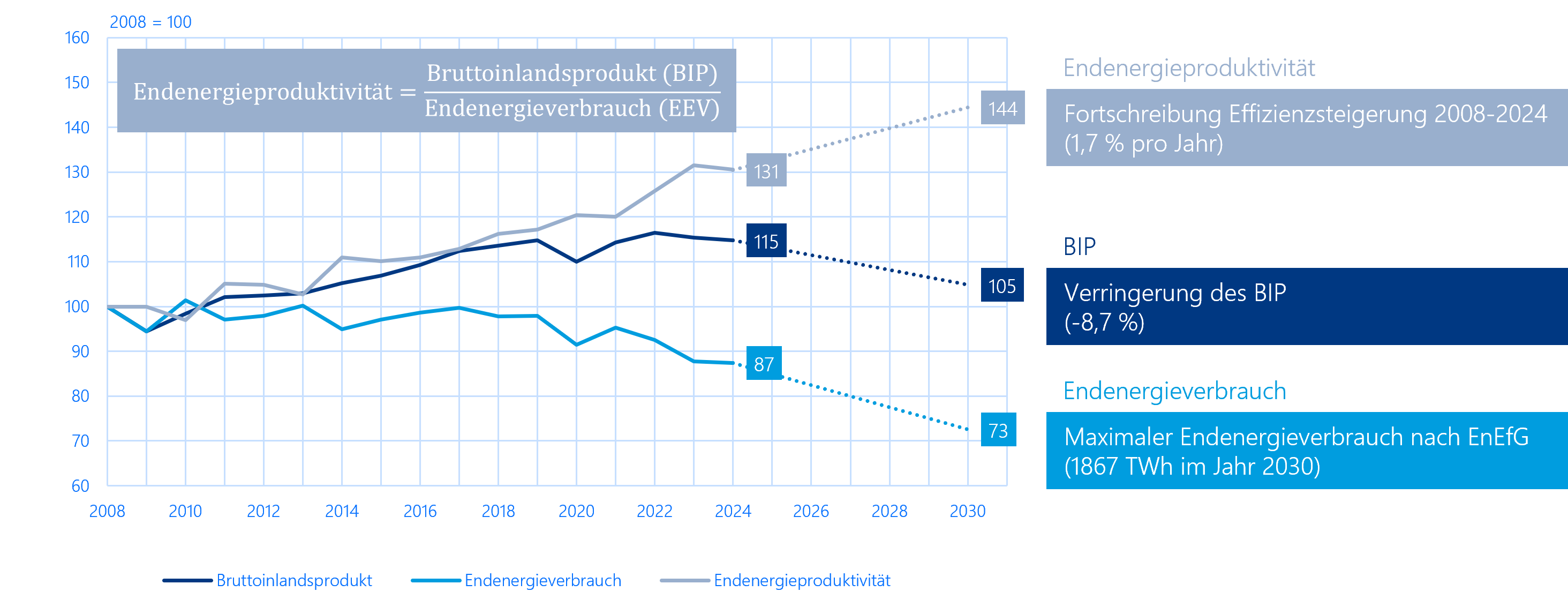
During the legislative process, the German Chamber of Commerce and Industry (DIHK) had urgently pointed out that such a target is not required under European law, but above all is economically highly risky. This is because: If the energy efficiency of the German economy continues to increase at its long-term average rate, the gross domestic product (GDP) would have to shrink by almost 9 percent compared to today’s level to achieve the target.
"Unter Fortschreibung des bisherigen Effizienztrends und bei strikter Einhaltung des vorgegebenen Ziels ergäbe sich, dass Deutschlands Wirtschaftsleistung bis 2030 um knapp neun Prozent im Vergleich zu 2024 schrumpfen müsste."

Peter Adrian
-- President of German Chamber of Commerce and Industry
Contrary to what the name might suggest, the law does not regulate energy efficiency, but instead caps energy consumption - regardless of whether it involves climate-neutral or harmful energy.
Scenario with continuation of the efficiency improvements achieved from 2008 to 2024 (1.7% p.a.):
Double efficiency delivers zero growth
From 2008 to 2024, GDP increased by 15 percent, while final energy consumption fell by 13 percent. The average efficiency improvement of the German economy was 1.7 percent. Assuming that energy efficiency continues to increase at the same rate in the coming years and energy consumption is limited in accordance with the law, GDP would shrink by about 9 percent compared to today’s level.
Scenario with zero growth (doubling of the achieved efficiency improvement to 3.3% p.a.):

To comply with the legally regulated energy consumption targets and achieve at least minimal growth, the annual efficiency improvement in the German economy would have to increase significantly. An increase of at least 3.3 percent per year would be necessary. This is twice as much compared to what has been achieved so far.
Type of energy generation remains disregarded
With the upcoming amendment to the Energy Efficiency Act, the chance to eliminate the growth-harming goal-setting will likely be missed again. In any case, the European Energy Efficiency Directive does not create an obligation for Germany to set legally regulated energy savings targets.
The law therefore not only ignores the link between energy consumption and economic performance but also fails to consider the type of energy generation (green versus fossil). Energy consumption can also be reduced through simple renunciation (e.g., closed-down productions) - without increasing economic efficiency, and it may even deteriorate. Conversely, higher but flexible energy consumption can contribute to stabilising an increasingly volatile renewable energy system, generate significant efficiency advances, and ensure prosperity.
DIHK Position Statement
- Download
-
Energieeffizienzgesetz
DIHK-Stellungnahme vom 7. Juni 2023 zum Entwurf eines Gesetzes zur Steigerung der Energieeffizienz und zur Änderung des Energiedienstleistungsgesetzes (Bundestagsdrucksache 20/6872)
- Information
-
File format: PDF (accessible)
File size: 645 KB
Status of: June 2026
Page count: 14 pages
(only available in German)
- Relevant in topic:
- Energie
- Key areas:
-
- Klima
- Wachstum
Released 01.06.2026
Modified 05.06.2026
Contact

Dr. Sebastian Bolay
Managing Director Energy, Environment, Industry

Erik Pfeifer
Head of Department for Corporate Climate Protection
