In the DIHK Newsroom, you’ll find the latest press releases, statements, studies, and background information on the German economy—presented in a concise, well-organized, and always up-to-date...
In light of the Acceleration Pact, many federal states have started simplifying their construction regulations and expediting approval procedures. In November 2025, the German Chamber of Commerce and Industry (DIHK) compared central legal regulations for approval acceleration across the 16 state building codes.
The DIHK Acceleration Monitor observes the central legal regulations for approval acceleration across the 16 diverse building codes. To simplify the comparison, seven key facilitation areas are analyzed: procedural freedom, simplified building approval processes, deadline reductions, presumption of approval, early construction commencement, and type approvals.
In the second half of 2025, multiple federal states have undertaken efforts to modernize their building codes and accelerate approval processes. This is set against the backdrop of the "Pact for Planning, Approval and Implementation Acceleration," agreed upon by the federal and state governments in November 2023, which proposes over 100 measures to simplify and digitalize administrative processes.
The DIHK Acceleration Monitor observes the central legal regulations for approval acceleration in the 16 diverse building codes. Seven core facilitation areas are analyzed for comparison purposes: procedural freedom, simplified building approval processes, deadline reductions, presumption of approval, early construction commencement, and type approvals.
It emerges that many federal states have already introduced regulations to accelerate procedures, and some even surpass the formulations of the acceleration pact. However, no state has fully implemented all resolutions from the federal-state pact. While the states are on a promising path, there is still potential for additional measures to enhance the speed of building approvals.
The results of the comparison:
The fastestbuilding permit is the one that does not need to be applied for. Toease the burden on companies and authorities, the German federal and state governments have decided to "completely exempt cases of minor importance from approval requirements". The list of so-called non-procedural building projects is extensive. Therefore, we compared only buildings, the special exception of attic conversions, and the exception for mobile phone masts.
This shows that just about half of the federal states have raised the threshold values of the Model Building Code (buildings in inner areas up to 10 m²). Lower Saxony is particularly progressive here, with a threshold for buildings up to 75 m³ of space in inner areas and up to 40 m³ in outer areas. Bavaria, North Rhine-Westphalia, and Saxony permit procedural attic expansionincluding dormers and loggias. In most federal states, this still requires an exemption procedure including all building documents. Mobile phone masts have been exempted nationwide in almost all federal states when they are up to 15 meters on buildings, up to 20 meters in outer areas, or mobile for a maximum of 24 months. In North Rhine-Westphalia, this is even possible for masts 20 meters above buildings or for mobile installations for up to 48 months at one location.
In the so-called simplified approval procedure, parts of the building application (specifically the building regulations) are not reviewed by the authorities. The federal government and states have therefore decided to expand the use of the simplified approval procedure. However, the extensive applicability of the procedure for all projects except special constructions, as already envisaged in the Model Building Code, has only been implemented by 9 of the 16 federal states so far. Seven states limit the application to residential buildings or certain building classes.
Despite statutory deadlines for approval decisions, procedures in practice take significantly longer. To ensure that exceeding the deadline does not go without consequences, the Model Building Code and many state building regulations stipulate that approval is considered granted if the authority has not rejected the application by the end of the deadline. The states had decided to introduce 'a nationwide uniform implicit approval period of three months.'
For various stages of the approval process, deadlines are set. This includes, in particular, the decision deadline starting from the completeness of the building application, the timeframe within which the authority must confirm the completeness of the application documents or request additional documents. Deadlines for responses are also given to participating authorities or other bodies. The federal and state governments have agreed to implement "appropriate deadline reductions" which vary greatly depending on the procedure and the federal state. The Model Building Code and some state building codes only specify deadlines for the simplified approval process. In contrast, Baden-Württemberg, Berlin, Brandenburg, and Hamburg impose much shorter deadlines of just a few weeks depending on the procedure.
(only available in German)
To prevent the need to repeatedly submit new documentation and evaluations for facilities of the same type or within the same systems, type approval exists. It will increasingly be applied, for example, in modular construction. To ensure manufacturers of these systems do not need to submit applications in each federal state separately, the states have agreed on the mutual recognition of approvals. Although this has essentially been established across all federal states, some states require additional confirmations or recognitions by their authorities or restrict recognition, for example, to barrier-free designs.
Damit die Baugenehmigung schnell und leichter erfolgen kann, fordern Unternehmen seit vielen Jahren eine lückenlose Ende-zu-Ende-Digitalisierung der Baugenehmigung. Das bedeutet, dass nicht nur die Anträge digital versandt werden können, sondern auch die Bearbeitung, Beteiligung, Ergänzung und Bescheinigung zentral und digital erfolgen. Wie weit dieser Prozess in den Bundesländern bereits implementiert wurde, kann dieser Monitor leider nicht abbilden. Auch die Bauordnungen müssen die Digitalisierung durch die Befreiung vom Schriftformerfordernis ermöglichen. Baden-Württemberg und Niedersachsen schreien die rein elektronische Kommunikation hier bereits explizit vor.
Outcome
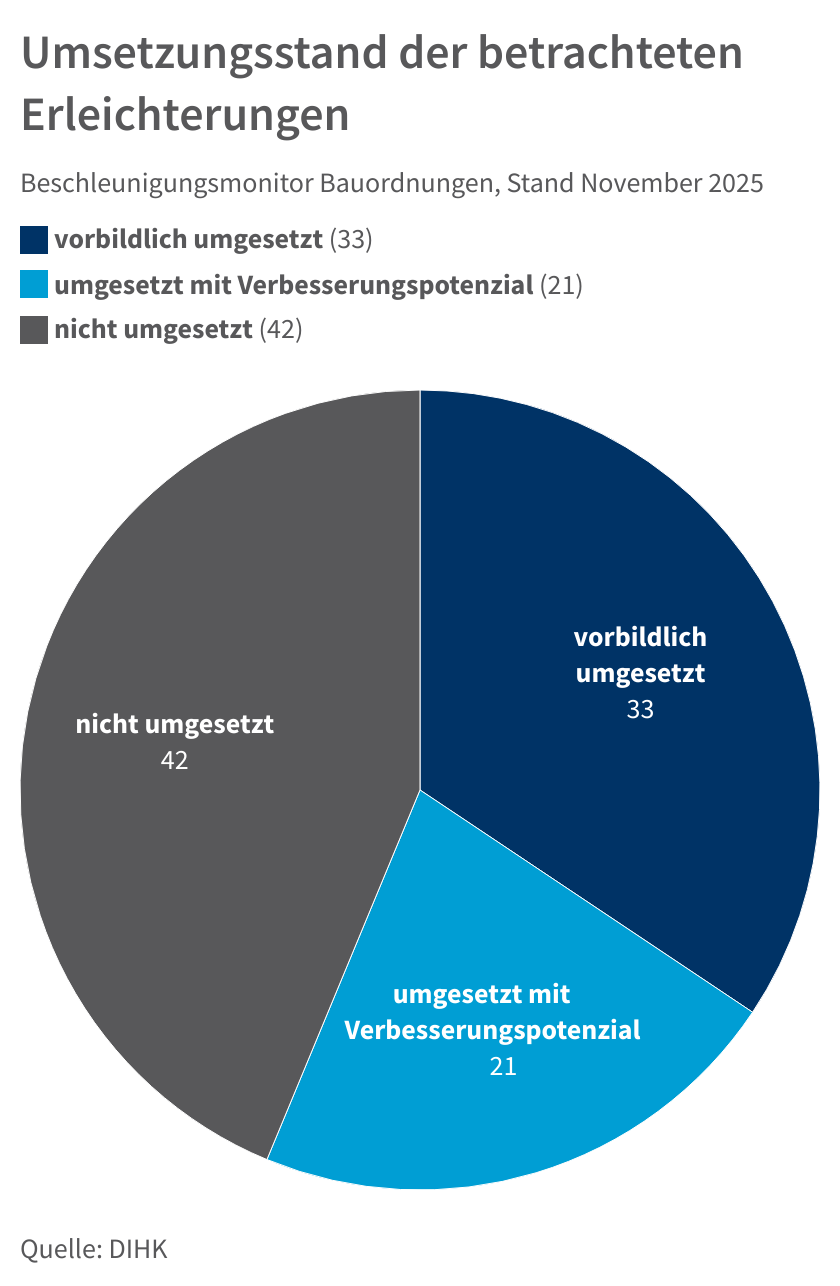
The comparison reveals that the states still have substantial acceleration potential within the selected regulatory areas of their building codes. Collectively, the federal states have implemented just over half of all possible procedural rules under the federal-state pact. Additionally, two-thirds of all possible regulations could still be optimized following those rules that most significantly shorten procedures.
No federal state has fully implemented the measures adopted in the federal-state pact as of yet. Therefore, there is still room for improvement in all states, and considerable work remains to be done.
Methodology
This monitoring could compare only a small fraction of potential regulations. Recently, many states have introduced additional facilitations, such as reduced verification requirements or simplified parking and fire protection regulations. Apart from expediting building plan procedures, reducing bureaucracy in construction regulations, and promoting digitalization, accelerating building codes remains a continuous challenge.
Download
The full monitor with tabular overviews is also available for download here:
This English version is provided for convenience only. It has been translated with the assistance of AI. No guarantee is made as to the accuracy or completeness of the translation.