In the DIHK Newsroom, you’ll find the latest press releases, statements, studies, and background information on the German economy—presented in a concise, well-organized, and always up-to-date...
Policy Dossier
Translated from German with AI assistance
Vocational training pays off
Masters, certified specialists, and others: professionally qualified individuals maintain a financial advantage almost their entire working lives.
The "reflex to study"
High school diploma in hand, and then? Go to college! That's the answer many young people give when faced with the choice between a degree or vocational training. The trend is increasingly in favor of university studies, as reflected in the labor market: nearly one-fourth of employed individuals (24 percent) today have attended a university, college, or vocational academy. At the same time, current projections show that the skilled labor gap among professionally qualified individuals will persist in this decade. Many sectors of the economy will continue to face significant challenges in recruitment.
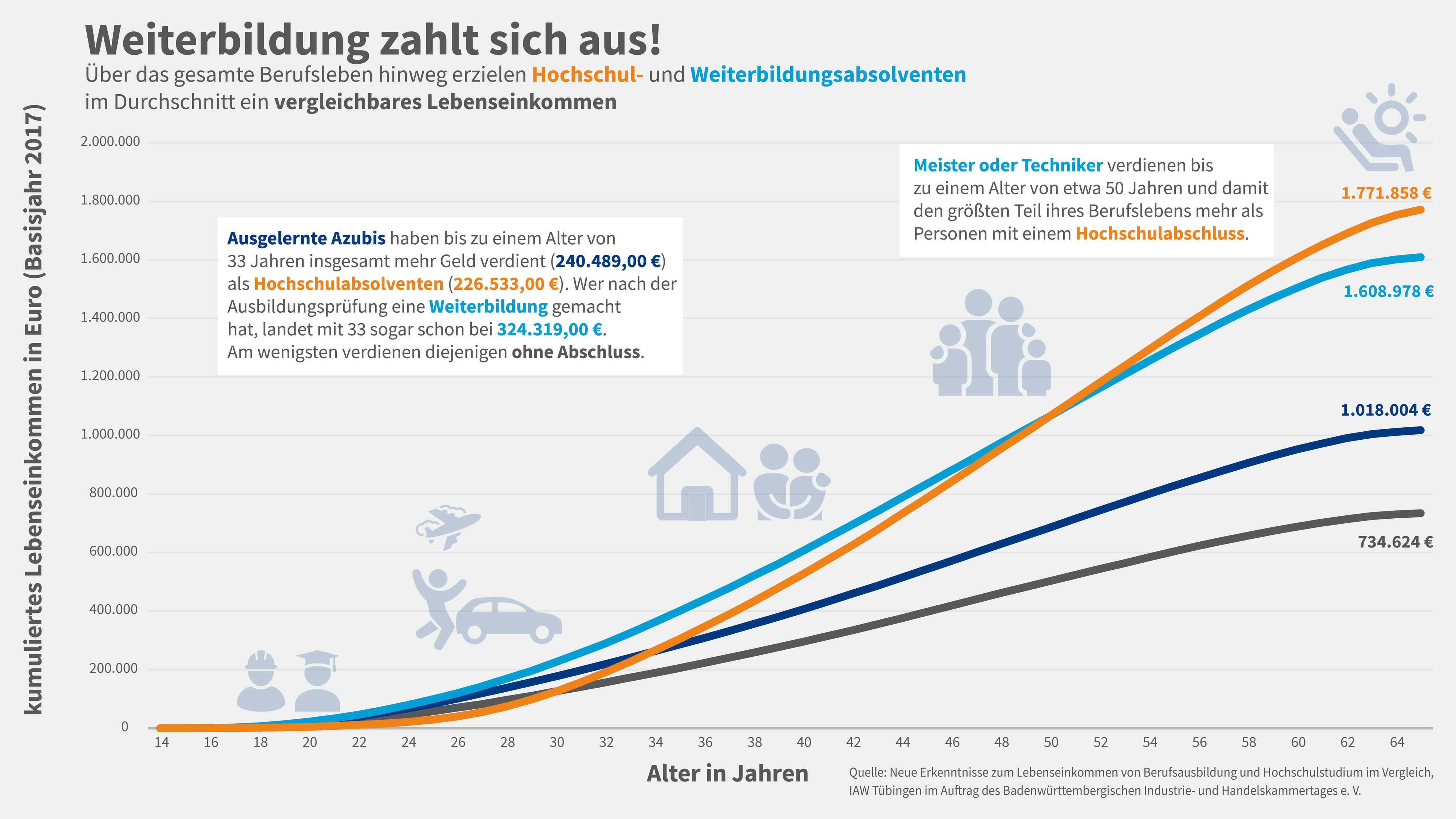
One possible reason for the ongoing pursuit of higher education qualifications is the widespread assumption that academics earn more money than professionally qualified individuals. But is this really true? Not necessarily. At the end of their working lives, academics and people with advanced professional qualifications—such as master craftsmen in metalworking or Bachelor Professionals in accounting—have earned about the same, roughly 1.7 million and 1.6 million euros gross, respectively. This is evidenced by a study by the Institute for Applied Economic Research at the University of Tübingen. (IAW, 2022)
Going on holiday, buying a car, acquiring property, or starting a family—for people with completed vocational training followed by additional qualifications, these goals are financially attainable.
While many academics don’t start working until their mid-20s and often have to pay off student loans, higher-qualified professionals who entered the workforce directly after finishing school and completed advanced professional education after their initial training already have a significant financial lead. Many university graduates manage to close this gap only much later—around the age of 50.
Academic Education versus Vocational Education and Training
In the group of academics, there are sometimes significant income differences: While a lawyer receives an average starting salary of around 59,000 euros gross, an architect at the beginning of his working life will only have an average salary of 42,000 euros gross on his pay slip. Graduates of social pedagogy or humanities often have to make even greater cuts in their earnings.
In contrast, the starting salary of skilled workers is often higher than one might think: banking professionals can expect a gross salary of up to €42,000. Similarly, industrial workers are highly sought after: a fully trained chemical technician is even compensated with up to €46,000 gross annually. After completing Higher Vocational Education, such as becoming an industrial foreman or certified accountant, top salaries of up to €80,000 gross annually can be achieved – of course, always dependent on the industry and company size. The classic prejudice that academics always earn more than non-academics is only partially true.
The high earnings of doctors and engineers raise the average salary among academically qualified individuals. Graduates of other academic programs often rank significantly below this. Vocational training – especially combined with a Higher Vocational Education qualification – can therefore be more lucrative than years of studying. This is particularly true when university graduates are forced to start their careers below their qualification levels.
Skilled labour shortages continue to be a challenge for businesses despite the prolonged economic downturn.
Vocational training provides a reliable pathway to employment security.
Finding employment aligned with one's academic qualification? This goal remains unfulfilled for many, especially Bachelor's degree holders, as revealed in the report "Education in Germany 2024," which states that one-sixth (15%) of graduates work in positions not requiring a degree (termed "inadequate employment").
Further Benefits of Higher Vocational Education and Training
For the majority of graduates from advanced vocational training courses (80 percent), this training has had positive effects on their career development according to the DIHK Success Study Education 2023 (PDF, 264 KB). This success is most frequently reflected in financial improvements and a higher position in their job with greater responsibility and tasks at hand (60 and 57 percent, respectively).
A study conducted by the German Federal Institute for Vocational Education and Training (BIBB) also shows that employees with advanced vocational qualifications often hold project, group, or team leadership roles (59 percent) and have independent budget responsibilities (37 percent). In addition, they often hold supervisory positions (45 percent) and frequently take on comprehensive personnel responsibilities. Accordingly, the perceived benefits of advanced vocational qualifications are rated highly by this group: For example, almost every newly certified master and technician was able to achieve a higher income; and more than two-thirds of them attribute high overall benefits to their advanced vocational qualification for their career development.
The success of continuing education is even more evident in its personal impact. Well over 90 percent, and thus the vast majority of graduates of an advanced vocational education examination, stated in the DIHK Continuing Education Success Survey 2023that continuing education was personally beneficial for them. Broadening perspectives (74 percent), improved understanding (70 percent), and gained confidence (54 percent) rank highest among the benefits. These personal effects mostly occur immediately after the examination. Men, in particular, report that they have significantly developed their soft skills through advanced vocational education.
Even during the transition from education and studies to working life, vocational training clearly has an advantage: According to a study conducted by respondi Market Research Institute, significantly more trainees feel well-prepared for a job compared to college graduates. Almost two-thirds (around 60 percent) of this group benefit from the high practical share of their dual education at career entry. Meanwhile, only 34 percent of academics feel well to very well prepared for working life, notably among professionals in the healthcare and production sector.
It is high time to question common prejudices. The career path through vocational—and more practice-oriented—training is a rewarding alternative to studying for many. This applies to young people in career choice as well as to companies seeking talents for a shared future. The German economy has benefited from company-oriented education and training for decades—and will continue to rely on top-qualified vocational specialists in the future!
This English version is provided for convenience only. It has been translated with the assistance of AI. No guarantee is made as to the accuracy or completeness of the translation.
Whether it's Power Grid Foremen or Business Economists: Advanced vocational training has greatly benefited graduates. How did this happen and how are they doing today? We have asked women and men who have pursued further education. Watch our compelling and personal videos here.
Higher vocational education pays off: POSITION spoke with practitioners from Erwin Hymer Group and the German Chamber of Commerce and Industry (IHK Bonn/Rhein-Sieg) about the benefits of further education for businesses and employees.
Contact
Julia Flasdick
Director Education Policy, Universities, Research and Structural Issues