Energy and Economy: Setting the Course for the Future

To enable companies to invest, transform, and secure jobs, energy policy must set clear priorities: affordable energy, rapid networks, and reliable plans. The DIHK brings the perspective of business directly into political decisions, highlighting where regulatory relief is needed and identifying the levers that effectively drive the expansion of renewable energies. Our goal: political framework conditions that enable climate protection while strengthening the industrial base.


Which focus areas are you interested in?

Results

60 results
Strommasten mit leuchtenden Kabeln

Why electricity tax must remain reduced permanently

The now universally agreed reduction of the electricity tax is a crucial signal for the economy. It has the potential to significantly relieve businesses, advance electrification and climate protection, and reduce bureaucracy. It is now essential that this agreement extends beyond 2027.

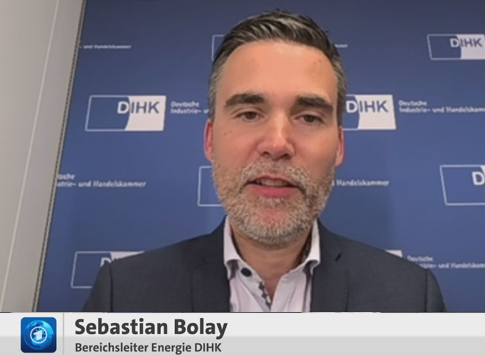
Screenshot vom Interview Sebastian Bolay

Electricity Tax: No one will want to announce an increase again in 2028

The newly agreed reduction in electricity tax must remain in place beyond 2027 so that companies can also plan with the reliefs – as pointed out by Sebastian Bolay, Head of Energy, Environment, and Industry at the German Chamber of Commerce and Industry (DIHK), in an interview with tagesschau.de.

Peter Adrian_Reaktion

The Reduction of Electricity Tax – An Important and Appropriate Initial Step

DIHK President Peter Adrian on the Coalition Committee

Date of publication 18.11.2026
Windräder vor Kurven

Why it is so important to lower electricity taxes

The German government has repeatedly promised to lower electricity taxes for everyone. According to the German Chamber of Commerce and Industry (DIHK), fulfilling this coalition agreement promise is economically, climate-politically, and psychologically of immense importance.

Peter Adrian_Reaktion

A Severe Disappointment for German Companies

DIHK President Peter Adrian on the repeated rejection of electricity price reductions for all

Date of publication 12.11.2026
3D-Modelle von Wasserstoffmolekülen

Successful with Hydrogen

No domestic market, no global success: German technology companies need a convincing showcase within their own borders to further develop their role in hydrogen technologies worldwide. How Germany can set the course for an efficient hydrogen market - and why fuel cell cars and hydrogen heating...

Associations Determine H2 Market Index 2026

The hydrogen ramp-up requires a reliable political course that enables investments and creates sustainable markets.

Date of publication 04.11.2026
Bolay, Sebastian

For the market ramp-up to succeed, rapid implementation is now crucial

Sebastian Bolay, Head of Energy, Environment, and Industry at the German Chamber of Commerce and Industry (DIHK), comments on the hydrogen policy by the Federal Ministry for Economic Affairs and Energy

Date of publication 19.10.2026
Peter Adrian_Reaktion

Reduction in electricity tax is overdue and necessary

German Chamber of Commerce and Industry (DIHK) on the German government's announcement to reduce electricity tax for all

Date of publication 12.10.2026
Ein Daumen zeigt nach oben, ein anderer nach unten

Does the Energy Transition Need a New Direction?

A "Pro and Contra" on the German Chamber of Commerce and Industry’s climate policy position.

Date of publication 08.10.2026
Sebastian Bolay Juni

Reducing Costs and Cutting Red Tape

DIHK on the Renewable Energy Act and the Energy Efficiency Act

Date of publication 05.10.2026
Sebastian Bolay Juni

We anticipate a pricing issue

DIHK Head of Energy, Environment, and Industry, Sebastian Bolay, on the current discussion about gas storage levels

Date of publication 17.09.2026
Reaktion von Volker Treier

Energy Tax Should Be Reduced to the European Minimum

Chief Analyst of the German Chamber of Commerce and Industry (DIHK), Volker Treier, on the rising energy prices

Date of publication 16.09.2026
Sebastian Bolay Juni

Reduction of the transmission system surcharge undermines efforts for permanently lower electricity prices

Sebastian Bolay, Head of Division for Energy, Environment, Industry at the German Chamber of Commerce and Industry (DIHK), on the surcharge for transmission system charges

Date of publication 02.09.2026
Solarfeld und Windkraftanlagen

Energy Transition Barometer 2026: Investments Leave Germany

Businesses in this country desire a climate policy that enables both decarbonisation and competitiveness. If this is not achieved, as shown by the latest DIHK Energy Transition Barometer, the already high risk of creeping deindustrialisation will continue to grow.