
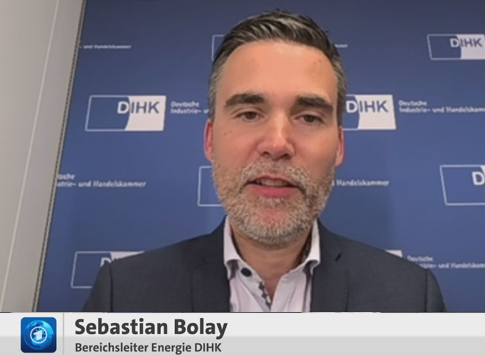
The agreement reached by the coalition committee of the CDU/CSU and SPD on the night of November 18 to reduce electricity tax for all to the European minimum rate was described by Bolay in his conversation with tagesschau.de as "very good news, which we have been awaiting for a very long time". If this measure, already outlined in the coalition agreement, had been implemented immediately, "it would certainly have strengthened trust, especially from the business community towards politics." However, this will now lead to significant relief, particularly for medium-sized businesses.
Permanent reduction helps businesses in a concrete way
For short-term planning, a one-year reduction is not particularly helpful for businesses, the DIHK department head conceded. However, the expectation is that no one will want to announce an increase again in 2028 and that "the federal government will manage to find these five billion euros in next year’s federal budget."
He strongly assumes that it will "no longer be politically feasible to increase electricity tax again in 2028." A permanent reduction would significantly lower costs for businesses, he calculated. A logistics provider could save about 200,000 euros on their fleet of electric trucks. For data centres, the relief would quickly amount to seven-figure sums. "So this will concretely help the economy", Bolay said.
Financing partly through the Climate and Transformation Fund
The federal government has several options for financing this, he pointed out. Leaving aside hopes for a substantial economic upswing that will expand budgetary leeway, the DIHK expert mentioned the Climate and Transformation Fund: This fund is backed by the CO2 price, which everyone pays when refueling or heating.
"The federal government has actually promised to give this money back to the economy and to citizens," he reminded. "We are talking about sums of 20 billion euros and more. Although these are allocated to various funding programs, in our opinion, one or two of these programs could certainly be trimmed, and at least part of the electricity tax reduction could be financed from this fund."
For example, the government is already taking 2.7 billion euros from this fund for the 2027 budget, Bolay said. "Thus, half of the electricity tax reduction has already been financed."
Funding programs are always selective
This does not necessarily have to come at the expense of other areas. On the one hand, there are many free-rider effects in funding programs; on the other, funds from these programs are often not fully utilized due to complex application bureaucracies. "From our perspective, it is always better to provide broad relief, allowing companies the option to decide how they will specifically achieve climate neutrality in their operations. Funding programs are always selective in the end."
Video link
The complete interview from November 18, 2026, is available at www.tagesschau.de.
- Relevant in topic:
- Energy and climate policy
- Key areas:
-
- Electricity Prices
It has been translated with the assistance of AI.
No guarantee is made as to the accuracy or completeness of the translation.
Released 19.11.2026
Contact
Dominik Ohlig
Press Office Duty Officer | Spokesperson

