


Early termination of vocational training has negative effects for both sides: companies lose potential skilled workers, and young professionals become discouraged. However, dropouts have underlying causes – strategic recruiting can counteract them.
Many companies in Germany face the challenge of filling their training positions with suitable young talent. Some receive no applications at all, while others struggle with mismatches between job requirements and applicant profiles. According to the "Training 2025" company survey by the German Chamber of Commerce and Industry (DIHK), 73 percent of companies with staffing difficulties reported being unable to find suitable employees in 2024 – a four-point increase compared to the previous two years. In this tense situation, early training dropouts add fuel to the fire. The "Training Report 2025" from the German Trade Union Confederation (DGB) reveals that nearly one-third – 29.7 percent – of training contracts were prematurely terminated, a record high.
Reasons for dropouts: unreal expectations
Main reasons cited for training dropouts in the DGB report include conflicts between trainees and trainers, poor training quality, unfavourable working conditions, or health problems – and also unreal expectations of the occupation. Companies also name this as a common reason for contract terminations, alongside a lack of performance or motivation. This makes well-grounded career guidance all the more crucial. "We therefore recommend enhancing career guidance and integrating it with existing measures by the Federal Employment Agency, federal states, and social partners. A practical career orientation helps young people find suitable pathways and avoid poor decisions," says Jana Heiberger, Head of Career Orientation, Vocational Schooling, and STEM Promotion at the DIHK.
To realistically present an occupational profile, companies should focus on clear and transparent communication. Job postings and corporate websites should accurately describe the occupational profile, training path, and necessary requirements. Personnel managers and training coordinators can ask themselves the following questions:
- Do we authentically portray the role with all key tasks, requirements, and potential challenges (physical, social, emotional)?
- Are we transparent about the course of training and key stages?
- Is the job posting motivating and does it convey development potential?
Transparency and authenticity as key elements
Authentic and deliberate communication in recruiting is a critical step in countering early training dropouts. Andreas Mecke, founder of Qualiteam Personal and author of the book "Neustart Recruiting" (Recruiting Reset), has been advising companies since 2020. He emphasizes: "Precision comes from authenticity. I advise companies to openly communicate their values, company culture, and requirements, while also focusing on the personality, attitude, and motivation of the job candidates. Practical selection processes, honest insights into the work environment, and structured onboarding reduce the risk of poor placements." To achieve the best match, companies should clearly state their expectations and the demands of the role but also showcase what they can offer through their training and career opportunities.
Alongside transparent communication, enthusiasm is crucial, says Andreas Mecke. Industries under pressure, such as hospitality, often address worker shortages with temporary labour or hiring part-time help – a short-term approach that undermines service quality and employee motivation. Instead, Mecke advises showing enthusiasm and investing in the quality of training: "Successful recruiting starts with a clear stance and enthusiasm for the profession. This attracts talent! Training dropouts result from poor guidance and lack of recognition. Clear structures, development discussions, and respectful collaboration form the foundation." Additional measures, such as trainee mentors or projects that allow trainees to independently implement initiatives, further strengthen their connection to the company.
Too few applicants? Use matching strategies
For many companies, a lack of applicants complicates the selection process even further. According to the DIHK publication "Training 2025," around 32 percent of companies with staffing difficulties did not receive any applications for their training positions in 2024 – a slight drop from 35 percent in 2023 but still alarmingly high. Particularly affected are the manufacturing, transport, and construction industries, where over half of companies (52 to 56 percent) were unable to fill their training positions in 2024.
Matching projects can help address the issue of few or unsuitable applicants, such as the "Targeted Placement and Welcome Mentors" programme, funded by the Federal Ministry for Economic Affairs and Climate Action (BMWE) and implemented by several IHKs. Chamber advisors act as "matchmakers," creating tailored requirement profiles in consultation, searching for potential trainees, and providing businesses with a preselection.
Opportunity: International recruiting
A major opportunity to fill training positions lies in international recruiting. Efforts by businesses, IHKs, and policymakers to promote immigration into training have already shown success, as summarised by the DIHK in the "Training 2025" publication. One in three companies has already attempted to train individuals from third countries – 30 percent successfully. More than half (57 percent) of companies are open to trainees from third countries, whereas smaller companies hesitate mainly due to organisational hurdles. The DIHK therefore advocates for reducing bureaucracy. They recommend that multiple reviews of training contracts by different authorities be eliminated. For chamber-regulated professions, review by the respective chamber should suffice. Hospitality and gastronomy illustrate how international recruiting provides solutions: 68 percent of businesses in these sectors have already trained trainees from third countries. Between 2023 and 2024, the industry managed to reduce unfilled training positions from 54 percent to 45 percent, as shown by the DIHK survey.
The "Targeted Placement and Welcome Mentors" programme also relies on the potential offered by international talents and the integration of refugees. Of the 4,900 placements achieved in 2024, around 800 involved refugees and 355 involved young people from EU and third countries. Interested companies can find information about international recruiting and search for welcome mentors in their area via postal code on the "Companies Integrating Refugees" network website. International recruiting can expand the talent pool while simultaneously increasing cultural diversity and inclusion within companies.
DIHK publication "Training 2025"
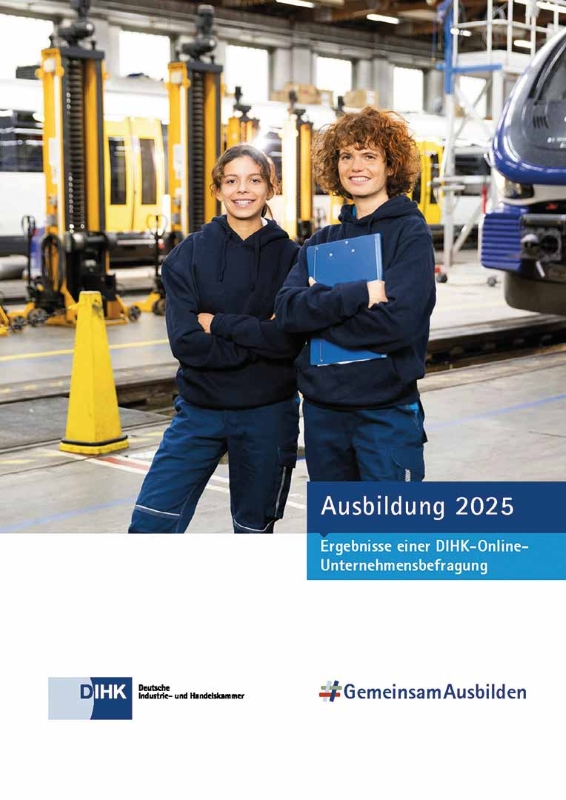
with survey results, graphs, and tables is available for free download (only available in German).
More Visibility for Your Training Placements
IHK Vocational Training Magazine POSITION
The article was published in an issue of the IHK Vocational Training Magazine POSITION .
The magazine is aimed primarily at instructors, examiners, and HR managers in IHK member companies.
- Relevant in topic:
- Service Portal
- Key areas:
-
- Position – Magazine for Trainers
- Vocational Training
It has been translated with the assistance of AI.
No guarantee is made as to the accuracy or completeness of the translation.
Released 14.07.2026
Modified 05.08.2026
Author

Sabine Biskup
Editor at UNIVERSUM Verlag GmbH