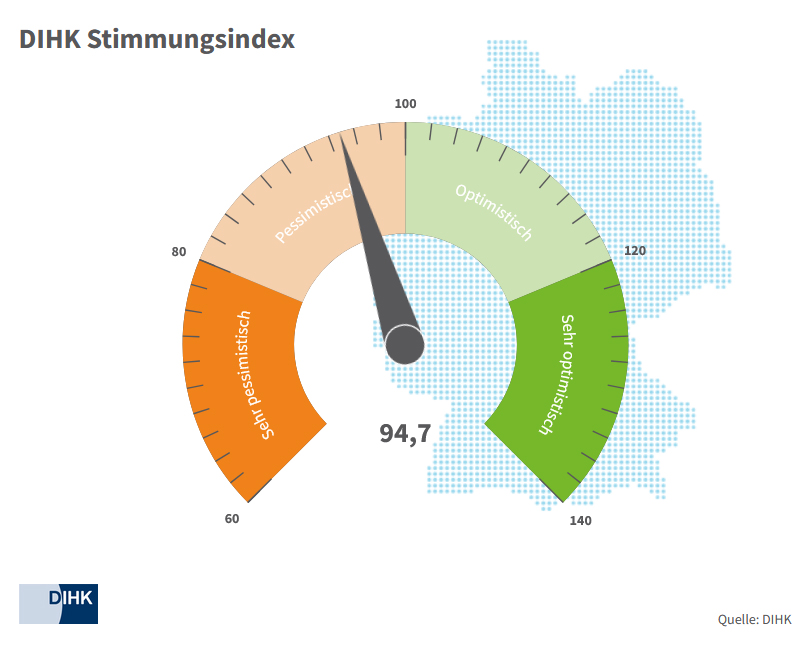
The responses of around 23,500 companies from almost all sectors and regions were evaluated. Their sentiment has significantly recovered since the slump in early summer, but remains predominantly pessimistic. The DIHK Sentiment Index, which combines business situation and expectations, rises from 88.1 to the current 94.7 points. However, it remains well below the long-term average of 110 points.
Key Findings
- Current Business Situation: Business conditions have improved compared to the early summer 2026 survey: Currently, 26% of companies rate their current business situation as "good," while 23% view it as "poor." The balance of these assessments rises from minus 3 to plus 3 points.
- Business Expectations: Business expectations are slightly brighter but remain noticeably negative: 15% of companies anticipate better business in the next twelve months, while 28% expect worse outcomes. The balance of business expectations improves from minus 20 to minus 13 points compared to the prior survey.
- Business Risks: Energy and raw material costs remain the most frequently mentioned business risk in the autumn survey (67%, previously 70%). Factors such as economic policy framework conditions (58%), labour costs (56%), and domestic demand (54%) are still ranked high.
- Export Expectations: Export expectations among industrial companies have risen again: Currently, 24% of exporting industrial firms expect rising exports, while 21% anticipate declines. The balance climbs back above the zero line to 3 points (early summer: minus 10 points).
- Investment Plans: Investment plans are no longer as restrictive as they were recently: 24% of companies plan increased budgets, although 30% still intend to reduce their investments. The resulting balance increases from minus 11 to minus 6 points.
- Employment Plans: The slight economic improvement is not reflected in companies' employment plans. 11% plan to expand their workforce, while 24% anticipate a reduction. The balance stands at minus 13 points, nearly as low as in the previous survey (minus 14 points).
After the sentiment dip in the early summer 2026 survey, the indicators stabilise. The shock of the Iran war and the Straits of Hormuz closure has so far been weathered by the German economy better than feared. Currently, companies benefit from a special economic boom: Public investments in infrastructure and security, financed by credit, are improving the business situation and expectations. In addition, robust global economic growth despite turbulences and the global AI boom fuel the economy. However, structural problems persist. The rise in energy costs due to the Middle East conflict, as well as high personnel expenses and excessive bureaucracy, continue to strain the German economy.
"The economy is granting us a breathing space, but no more than that. What we are currently seeing is an upturn on borrowed money."

Dr. Helena Melnikov
-- Chief Executive Officer
Current Business Situation
Businesses evaluate their situation better than in early summer: The proportion of companies reporting a poor business situation drops from 26 to 23 per cent; those reporting a good situation increase from 23 to 26 per cent. The balance turns from minus 3 to plus 3 points – the highest value since early summer 2024 (plus 5 points), though still far from the long-term average (plus 19 points).
Seasonality also favours the construction industry (balance plus 12 points, previously plus 7 points) and service providers (balance plus 10 points, previously plus 3 points). Manufacturing approaches the break-even line (minus 1 point, previously minus 7 points). The retail sector remains under strain, though the balance has improved to minus 18 points (previously minus 21 points).
Business Expectations
Firms are less pessimistic about the future compared to early summer, but overall expectations remain negative. Fifteen per cent (previously 13 per cent) anticipate better business, while nearly twice as many expect a decline (28 per cent, previously 33 per cent). The balance of business expectations rises by 7 points to minus 13 points, still 15 points below the long-term average.
Industry remains most optimistic about its outlook (balance minus 4 points) and has seen the sharpest recovery (up 12 points). However, in the construction sector, expectations slightly decline seasonally (minus 22 points, previously minus 20 points).
Business Risks
The economic repercussions of the Middle East conflict remain visible in risks perceived by companies. Energy and commodity prices remain the top issue (67 per cent, previously 70 per cent). While slightly reduced, this figure remains significantly above the long-term average of 45 per cent. Second place remains economic policy conditions, deemed a risk by 58 per cent of companies.
Labour costs are still cited as a risk by 56 per cent (early summer 57 per cent). This includes not just general wage increases but also social security contributions and the rising statutory minimum wage. Domestic demand remains a significant concern (54 per cent, previously 56 per cent), exacerbated by uncertainty stemming from the Middle East conflict.
On average, each company currently faces 3.05 risks simultaneously – a slight decrease from early summer (3.13) but close to the peak of 3.2 in autumn 2022.
Export Expectations in Industry
Thanks to easing external uncertainties, export expectations in industry improve significantly. Following a setback in early summer, almost a quarter of manufacturers (24 per cent, previously 19 per cent) now expect growing exports, while just over a fifth (21 per cent, previously 29 per cent) expect a decline. The export expectations balance rises sharply from minus 10 points to plus 3 points, the highest since early 2022, though still below the long-term average (plus 13 points).
Correspondingly, only 38 per cent of exporting manufacturers now consider weak foreign demand as a business risk, compared to 45 per cent in early summer and the long-term average.
Investment Plans
Investment prospects remain gloomy despite slight improvements: 24 per cent plan to expand budgets (previously 23 per cent), while 30 per cent (previously 34 per cent) plan cuts. The resulting balance improves from minus 11 to minus 6 points. Investment plans have remained consistently negative since autumn 2023, leaving companies increasingly dependent on existing resources.
Companies continue to focus on replacing machinery, systems or equipment, with 66 per cent in autumn 2026 citing replacement needs as the main reason for investment. This remains just below the peak (early summer 67 per cent). Capacity expansion remains a marginal factor for 19 per cent – the lowest since autumn 2003 (15 per cent). Product innovation also plays a subordinate role (28 per cent, previously 27 per cent).
Employment Plans
Amid structural economic stagnation, there is no turnaround in employment plans. Unchanged at 24 per cent of firms plan with fewer personnel, while only 11 per cent (previously 10 per cent) aim to increase employment. The balance improves slightly by 1 point to minus 13 points. Employment prospects are lowest in the retail sector (balance unchanged minus 20 points) and industry (balance minus 16 points, previously minus 20 points). The service sector offers comparatively better employment opportunities (balance minus 11 points, previously minus 10 points). In construction, however, seasonal factors lower hiring plans (balance minus 12 points, previously minus 9 points).
Negative employment plans are mirrored in concerns about skill shortages. Previously a pressing issue for 60 per cent of companies during the pandemic, currently 36 per cent are concerned – lower than the long-term average of 45 per cent. Although no longer a top concern for the broader economy, certain sectors, such as civil engineering (70 per cent) and road haulage (61 per cent), continue to struggle with substantial labour shortages.
DIHK Forecast
The DIHK anticipates 1 per cent growth for 2026 and 2027. However, a sustainable economic upturn is unlikely, particularly given the prolonged investment downturn. To prevent the fragile recovery from becoming just a brief respite, competitive energy prices, lower labour costs, faster approval processes, and reduced bureaucracy are essential.
Downloads
- Publication
-
DIHK Economic Survey Fall 2026
- Summary
- The basis of the DIHK results from fall 2026 is surveys conducted by a total of 79 chambers of commerce and industry (IHKs) among companies between September 7 and October 2, 2026. In total, the IHKs evaluated 23,500 responses. The responses are distributed by economic sector as follows: industry (25 percent), construction (7 percent), trade (21 percent), and service providers (47 percent).
- Information
-
File format: PDF (accessible)
File size: 8 MB
Status of: November 2026
Page count: 32 pages
- Publication
-
Evaluation Folder: All Figures on the Current Survey (only available in German)
- Summary
- The evaluation folder for the DIHK Economic Survey Autumn 2026 contains all figures from the current and previous surveys – some data extends back to 2003. Numerous graphs provide an overview, while a dashboard and an industry comparison offer interactive display options.
- Information
-
File format: XLSX
File size: 634 KB
Status of: November 2026
- Relevant in topic:
- Economic and Fiscal Policy
- Key areas:
-
- Economic Outlook
- Employment
- Growth
It has been translated with the assistance of AI.
No guarantee is made as to the accuracy or completeness of the translation.
Released 05.11.2026
Modified 04.11.2026
Ansprechpartner

Dr. Jupp Zenzen
Director Economic Analysis, Business Surveys