

The high cost of electricity already imposes massive burdens on businesses. At the same time, the role of electricity on the path to climate neutrality is expected to grow significantly. Reducing the electricity tax is thus vital not only for the competitiveness of businesses but also for climate protection.
Whether in heating, transport, or industry: Electricity is expected to displace fossil fuels like natural gas and oil in almost all sectors of the economy, thereby reducing CO2 emissions. Meanwhile, electricity demand is increasing due to digitalisation and AI applications. Affordable power is becoming an increasingly decisive factor for competitiveness and location attractiveness.
However, electricity is currently more expensive in Germany than in almost any other country in Europe. This makes electricity unattractive to businesses and hampers investments in new technologies and business fields within Germany. It's not just due to the recent market price increases caused by conflicts like those in Ukraine and Iran. The primary reason lies in the high ancillary costs: network charges and state-imposed taxes and levies make up more than half of the electricity price for commercial customers and households.
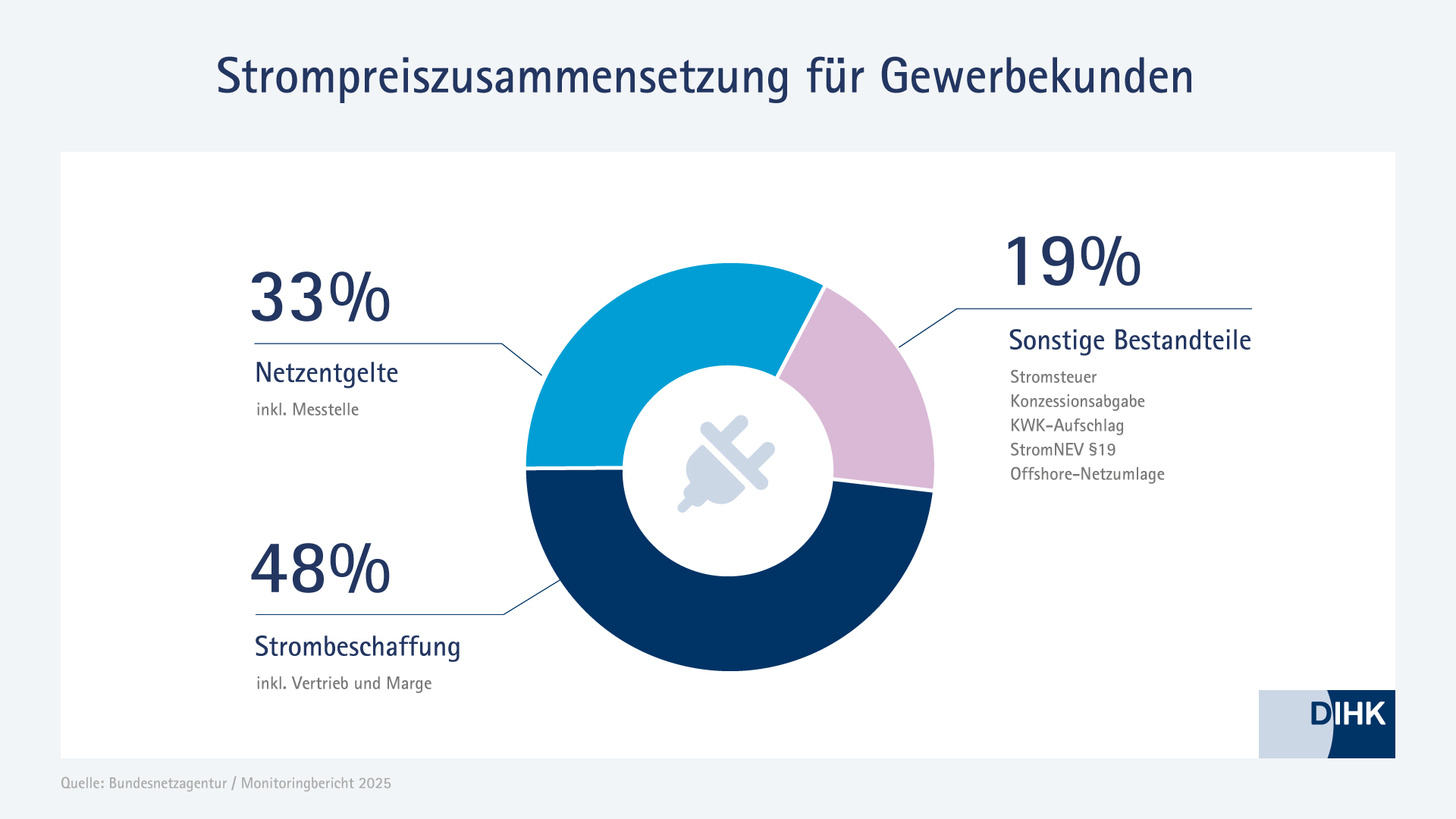
A significant portion of these costs comes from network fees. Recently, the state subsidised these by around €6.5 billion. However, the 15% reduction in this subsidy announced in early September 2026 significantly undermines efforts to achieve permanently lower electricity prices, criticised Sebastian Bolay, DIHK department head.
Reduce electricity tax to EU minimum
It is all the more critical that Federal Chancellor Friedrich Merz has now announced a reduction in electricity tax to the European minimum. The federal government had already promised this in its coalition agreement but has so far only partially implemented it: to relieve industrial companies, it reduced the electricity tax for manufacturing industry last year to the minimum amount mandated by the EU.
However, high electricity costs affect not only the industrial sector but the entire economy. "Retail companies, hotels, data centres, laundries, cold storage facilities, car dealerships, or other service businesses also rely on affordable electricity. Relief should not be limited to specific sectors but should benefit as many companies as possible," demands DIHK President Peter Adrian.
For households and non-manufacturing businesses, the electricity tax currently stands at 2.05 cents per kilowatt hour. The European minimum is 0.05 cents per kilowatt hour for companies. According to DIHK's model calculations (see below), a hotel would save approximately €10,000 per year, a shopping centre €200,000, and a large data centre roughly €1 million.
Strengthening climate protection and resilience
A lower electricity tax would not only relieve businesses financially but also promote investments and climate protection in Germany. Lower electricity prices make the use of electricity more attractive and contribute to the transition from oil and gas to climate-friendly, electricity-based applications. This ensures financial incentives without bureaucratic funding programmes and complex application processes for a broader audience.
Additionally, if the use of electric vehicles, heat pumps, and other electricity-based technologies becomes more economical, companies can also reduce their dependence on oil and gas imports and developments in international raw material markets.
"The announced electricity tax reduction is long overdue and appropriate. It relieves the economy and strengthens the demand for renewable electricity," explains Adrian. "Given the war in the Middle East and overall rising energy costs, any relief for businesses is important. What matters now is to quickly turn words into deeds."
Three case studies
In the following examples, the DIHK has calculated how much electricity tax companies currently pay under the existing relief regime according to § 9b StromStG. In each case, non-favoured and favoured (industrial) companies are compared. For the latter, the electricity tax is calculated at the minimum rate of 0.05 cents per kilowatt hour, plus a deductible of €250.
A procurement price (EEX Future Peak as of 1 July 2024 for the year 2025) of 10.078 cents per kilowatt hour, plus a fictitious supplier margin of 5% for low and medium voltage cases and 3% for high voltage cases, was applied.
The total does not include network costs, additional taxes, levies, and similar charges.
Procurement (euros) | Electricity tax (euros) | Total (euros) | |
|---|---|---|---|
Low voltage – annual electricity consumption 500 megawatt hours | |||
| Hotel | 52,910 | 10,250 | 63,160 |
| Industry: Vegetable processing | 52,910 | 500 | 53,410 |
Medium voltage – annual electricity consumption 10 gigawatt hours | |||
| Amusement park | 1,058,190 | 205,000 | 1,263,190 |
| Industry: Mechanical engineering | 1,058,190 | 5,250 | 1,063,440 |
| |||
| Data centre | 5,190,170 | 1,025,000 | 6,215,170 |
| Industry: Paper mill | 5,190,170 | 25,250 | 5,215,420 |
It has been translated with the assistance of AI.
No guarantee is made as to the accuracy or completeness of the translation.
Released 20.10.2026
Contact

Dr. Niclas Wenz
Director Electricity Market, Renewable Energy and National Climate Protection