


Many companies are desperately searching for qualified personnel, often overlooking a major potential within their own operations: employees who have proven their skills in their everyday work for years but lack a recognised vocational qualification. Partial qualifications (PQs) create an opportunity here. They allow individuals to gradually demonstrate and build professional competencies – up to achieving a recognised vocational qualification. For companies, this means they do not always need to rely on external hires for skilled professionals.
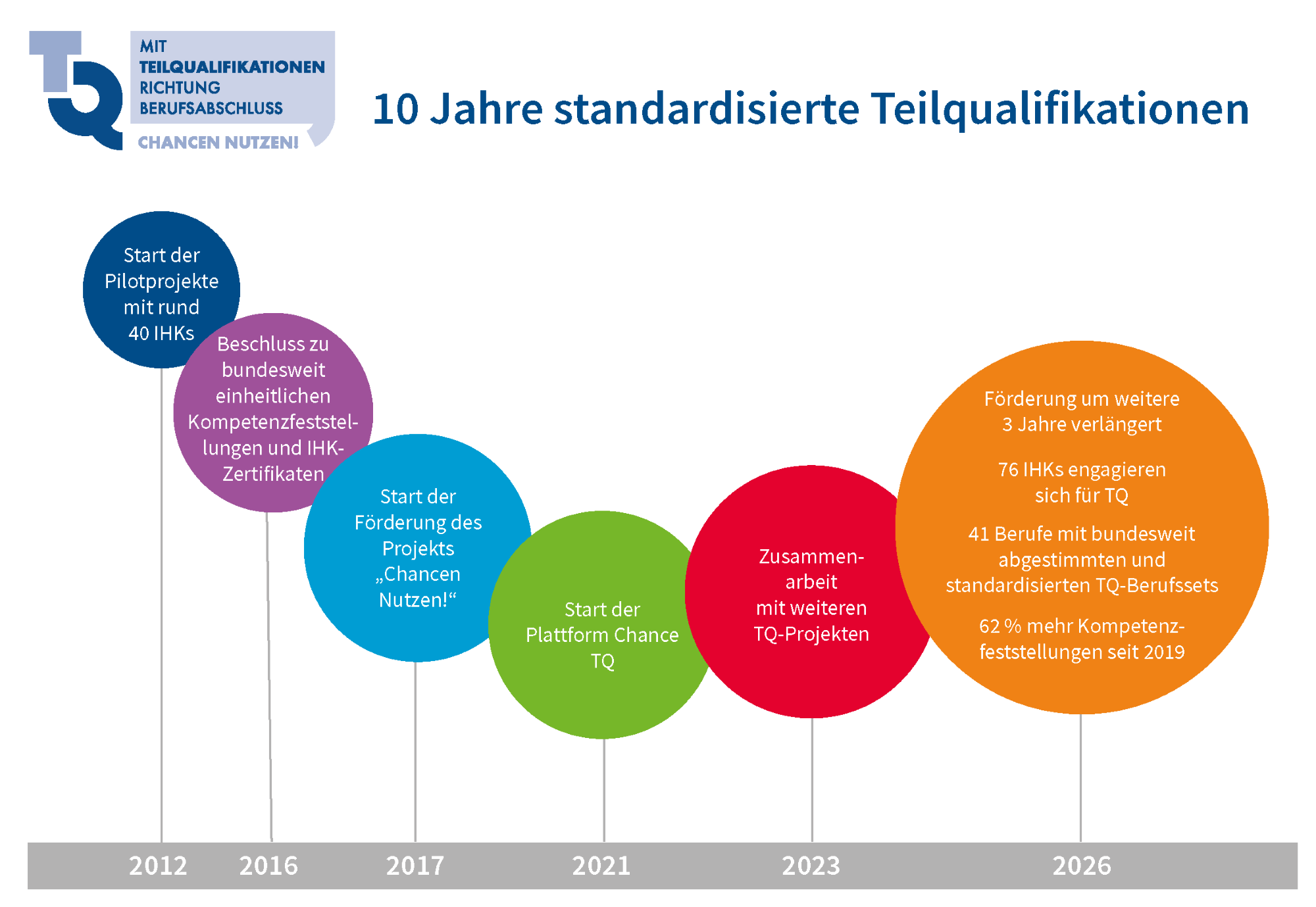
The growing importance of this approach is evidenced in 2026 in two ways: The project "Utilising Opportunities! Towards Vocational Qualifications with Partial Qualifications" will continue to receive funding from the Federal Ministry of Education and Research (BMBFSFJ) for an additional three years starting October. At the same time, the German Chambers of Commerce and Industry (IHKs) celebrate a special milestone: Since a resolution by their chief executives in 2016, the IHKs have been conducting nationwide standardised competence assessments for successfully completing PQs and awarding IHK certificates. A significant foundation for the standardisation and quality assurance of PQs within the IHK organisation was laid ten years ago.
Step by step to a qualification
The concept behind partial qualifications is simple: not everyone can or wants to undertake a complete training programme to achieve a vocational qualification. As such, recognised professions are divided into several progressive modules called partial qualifications. After each module, participants demonstrate their competencies in an IHK assessment and receive an IHK certificate. Those who successfully complete all required partial qualifications can qualify for the external examination and thereby obtain a recognised vocational qualification.
Partial qualifications offer several advantages for companies:
- Skilled workers can be developed from within the company.
- Employees remain closely tied to the company during the qualification process.
- Existing professional skills are recognised and systematically expanded.
- The qualification path is transparent and directly aligned with recognised training professions.
- Funding opportunities from the German Federal Employment Agency can provide financial support for further training.
The roots of PQ initiatives within the IHK organisation date back to 2012 when around 40 IHKs gained initial experience with partial qualifications and competence assessments during pilot projects. The goal was to develop and implement nationwide uniform quality standards in practice.
The 2016 resolution gave crucial momentum to this development. Since 2017, the Federal Ministry of Education has supported the project "Utilising Opportunities! Towards Vocational Qualifications with Partial Qualifications" in advancing and embedding standardisation. Since 2021, the project has also been collaborating with other federally funded PQ initiatives to further develop common standards and enhance transparency for businesses and participants.
All information on one platform
An additional milestone followed in 2024 with the launch of the "Chance TQ" platform: Companies, education providers, and interested parties can find comprehensive information about partial qualifications there. Nationwide, standardised qualification modules are available for 41 professions – ranging from commercial to technical and industrial fields.
The increasing establishment of partial qualifications is reflected in numbers. By 2026, 76 IHKs are engaged in PQs. At the same time, demand continues to rise: Between 2019 and 2025, the number of competence assessments increased by almost 62%.
Even included in the coalition agreement
Political support is also growing. In the current coalition agreement, partial qualifications are explicitly mentioned as an instrument for sustainably integrating more adults without vocational qualifications into the labour market.
Another significant step followed at the end of 2025: The Federal Institute for Vocational Education and Training (BIBB) main committee adopted a joint recommendation for the quality-assured design and implementation of partial qualifications. For the first time, social partners, chambers, federal ministries, states, and the Federal Employment Agency agreed on common quality standards and construction principles for PQs.
Your point of contact: the local IHK
For businesses, getting started is often straightforward: Those interested in partial qualifications should reach out to their regional IHK. Companies receive information about the next steps, suitable offerings, and potential funding opportunities. This allows firms to determine how to specifically develop their employees towards vocational qualifications.
For companies seeking to address the shortage of skilled professionals beyond job advertisements, partial qualifications are worth considering as the sought-after skilled workers are often closer than one might think.
More information about the project and all standardised partial qualifications can be found at www.chance-tq.de.
IHK Vocational Training Magazine POSITION
This article will appear in the autumn edition of the IHK Vocational Training Magazine POSITION, which is published in the final quarter of 2026.
The magazine is primarily targeted at trainers, examiners, and HR professionals in companies that are members of the German Chamber of Commerce and Industry (IHK).
(only available in German)
- Relevant in topic:
- Service Portal
- Key areas:
-
- Vocational Training
It has been translated with the assistance of AI.
No guarantee is made as to the accuracy or completeness of the translation.
Contact
Thilo Kunze
Director Info Center, Editor-in-Chief POSITION