Many businesses have long anticipated this agreement: Mid-November, the coalition committee of the Union and SPD decided to reduce electricity tax to the European minimum rate for all. While fundamentally positive news, the reduction is currently only valid until 2027. For companies planning investments, production processes, or the replacement of their fleet, a short-term relief step is hardly helpful. They require reliable framework conditions – and assurance that electricity tax will not increase the following year.
Affordable electricity is location policy
Electricity prices are becoming increasingly significant: in industry, heating, and transport, electricity is poised to replace oil and gas. At the same time, digitalisation and artificial intelligence applications are increasing demand. Affordable electricity is therefore not just a cost issue but a location factor: it determines whether investments in Germany are profitable and how quickly businesses can adopt new technologies.
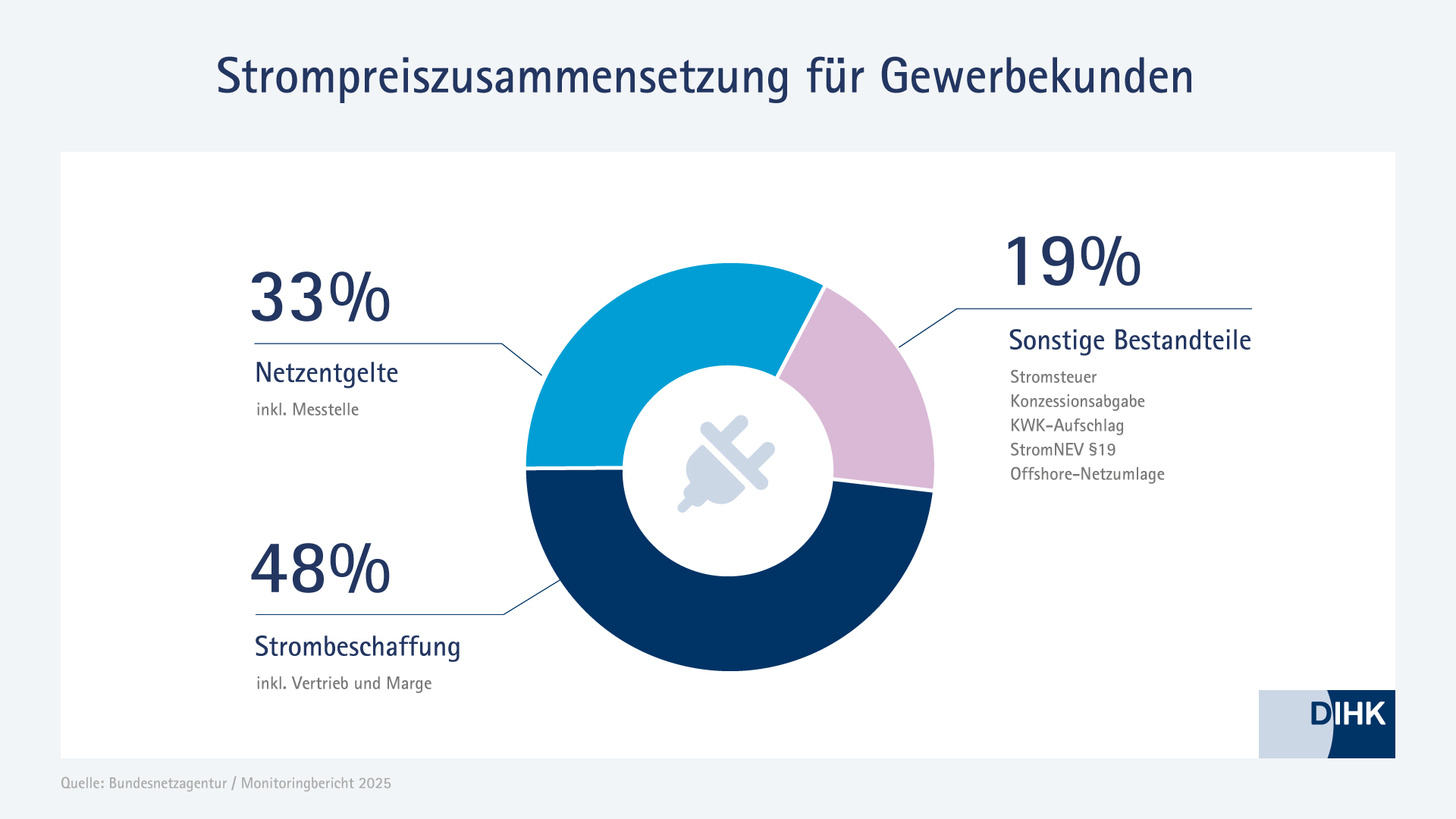
High electricity costs hinder this transition. Besides market prices, network charges and government taxes and levies account for over half of electricity costs for commercial and residential customers. As a result, businesses in Germany currently pay more for electricity than in most other countries worldwide.
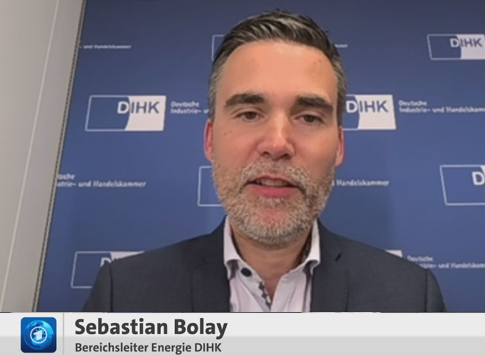
A significant portion of these costs comes from network charges. Recently, the government subsidised these charges with approximately €6.5 billion. However, the 15% subsidy cut announced in early September 2026 severely undermines efforts to reduce electricity prices sustainably, as criticised by DIHK Head of Division Sebastian Bolay.
Lower costs, less bureaucracy, more fairness
It is therefore all the more important that the coalition agreement now aims to reduce electricity tax to the EU-permitted minimum. At the beginning of 2026, the government had already introduced a permanently reduced rate for manufacturing businesses – but claiming it involves significant bureaucracy. If the tax is reduced to the minimum for everyone, the associated delineation, proof, and application procedures can also be eliminated.
The previous unequal treatment between manufacturing and other businesses would also end. After all, hotels, trading companies, data centres, laundries, cold stores, or car dealerships rely on affordable electricity too. "Relief should not be limited to specific sectors but should benefit as many companies as possible," emphasises DIHK President Peter Adrian.
As of November 2026, households and non-manufacturing businesses still pay 2.05 cents per kilowatt-hour in electricity tax. The European minimum rate stands at 0.05 cents per kilowatt-hour for businesses. According to DIHK model calculations (see below), reducing the tax would save hotels around €10,000 per year on average, shopping centres €200,000, and large data centres about €1 million annually.
Financing is feasible
What matters to businesses is not just the extent of the relief but also its duration. A one-year reduction contributes little to their planning efforts. They will only invest in electrification if electricity prices remain consistently low. This would pay off: a logistics company with an e-truck fleet could save around €200,000; data centres could save millions annually. Concurrently, businesses’ competitiveness would be enhanced.
According to the German Chamber of Commerce and Industry, financing the measure beyond 2027 is very feasible. DIHK President Peter Adrian notes the approximately €650 billion the federal government will mobilise in 2027 through the federal budget and special funds such as the Climate and Transformation Fund. The electricity tax reduction costs roughly €5.4 billion. Allocating less than one percent of total federal resources for a long-overdue relief step must be possible, Adrian argues. "Political priorities here are evidently misaligned."
From the Climate and Transformation Fund alone, €2.7 billion is already flowing into the 2027 federal budget – half of the tax reduction would already be covered. Using the fund consistently to finance the reduction would also be advantageous compared to subsidy programs. Beyond windfall gains and unused resources, broad relief is always preferable to targeted grants from an economic standpoint.
Boosting climate protection and resilience
A sustainably lower electricity tax would not only provide financial relief to businesses but also advance investments and climate protection within Germany. Lower electricity prices make electricity usage more attractive and help accelerate the shift from oil and gas to climate-friendly electricity-based applications. This approach ensures financial incentives are available broadly without intricate subsidy programs and cumbersome application processes.
Additionally, if the use of electric vehicles, heat pumps, and other electricity-based technologies becomes more economically viable, companies can decrease their dependence on oil and gas imports as well as the volatility of international commodity markets.
Ultimately, according to DIHK President Adrian, a reduction in electricity tax is "overdue and essential." However, it must extend beyond 2027 because "consistently low electricity prices are indispensable for economic reasons, climate protection, and digital transformation, ensuring Germany remains a robust business location."
Three case studies
The DIHK calculated electricity tax under the current relief regime (§ 9b Electricity Tax Act) for businesses in the following scenarios. Comparisons are made between non-privileged and privileged (industrial) businesses. (For the latter, the tax is calculated based on a minimum rate of 0.05 cents per kilowatt-hour plus a deductible of €250.)
The procurement price used (EEX Future Peak on 1 July 2024 for 2025) is 10.078 cents per kilowatt-hour, plus a fictional supplier margin of 5% for low and medium voltage cases and 3% for high voltage cases. The total excludes network charges and additional taxes, levies, and fees.
Procurement (€) | Electricity tax (€) | Total (€) | |
|---|---|---|---|
Low voltage – annual electricity consumption of 500 megawatt-hours | |||
| Hotel | 52,910 | 10,250 | 63,160 |
| Industry: vegetable processing | 52,910 | 500 | 53,410 |
Medium voltage – annual electricity consumption of 10 gigawatt-hours | |||
| Amusement park | 1,058,190 | 205,000 | 1,263,190 |
| Industry: mechanical engineering | 1,058,190 | 5,250 | 1,063,440 |
High voltage – annual electricity consumption of 50 gigawatt-hours | |||
| Data centre | 5,190,170 | 1,025,000 | 6,215,170 |
| Industry: Paper Mill | 5,190,170 | 25,250 | 5,215,420 |
- Relevant in topic:
- Energy and climate policy
- Key areas:
-
- Electricity Prices
It has been translated with the assistance of AI.
No guarantee is made as to the accuracy or completeness of the translation.
Released 20.11.2026
Modified 23.11.2026
Contact

Dr. Niclas Wenz
Director Electricity Market, Renewable Energy and National Climate Protection